
Air Hockey on CrazyGames
Dockside Air Hockey goes through Basic Launch on CrazyGames
▸More posts (6)
It has been quiet on this blog for a couple of months. I quit Swedish snus and took a long vacation, so the new Dockside Labs projects have been lying low. But before the summer break something happened that deserves a write-up: Dockside Air Hockey went through Basic Launch on CrazyGames.
If you have read my previous posts, you know that I rebuilt my old air hockey prototype into a real-time multiplayer game and deployed it across two regions. What I did not have was players. My Reddit promotion got 450 clicks and exactly one signup. Building the game turned out to be the easy part. Getting people to actually play it is much harder.
So I submitted the game to CrazyGames, a browser game platform with over 40 million users. To my surprise, it was accepted into Basic Launch on the first try. There are so many games being developed out there, and my first game made it onto one of the biggest game portals on the web. I consider that an accomplishment in and of itself.
The invite system
Integrating their SDK meant wiring up auth, audio muting and a handful of platform settings. The part I want to highlight though is the invite system. On CrazyGames, when you create a game you can invite friends on the platform directly. They get a notification and land straight in the lobby of your newly created game. No copying links and pasting them into a chat, which is the flow that the browser version at play.airhockey.app still relies on. It worked exactly how you would want it to, and it made playing with a friend feel effortless in a way my own version never quite did.
The trial
Basic Launch means that CrazyGames puts your game in front of real players and measures three things: gameplay conversion, average playtime and D1 retention. Each is scored 1 to 5, and you need 9 out of 15 to advance to a full launch.
For a few weeks, my dashboards saw more traffic than ever before. Over 400 accounts were created and well over 1000 guest plays came through. That is more players than all of my own promotion attempts combined, by a wide margin.
Most of them played a couple of games against the AI and left. But some played over 30 games against their friends. Seeing those sessions come in was really motivating. It brings a sense of pride to see someone enjoy your creation, even if it was just a tiny minority of the players.
The verdict
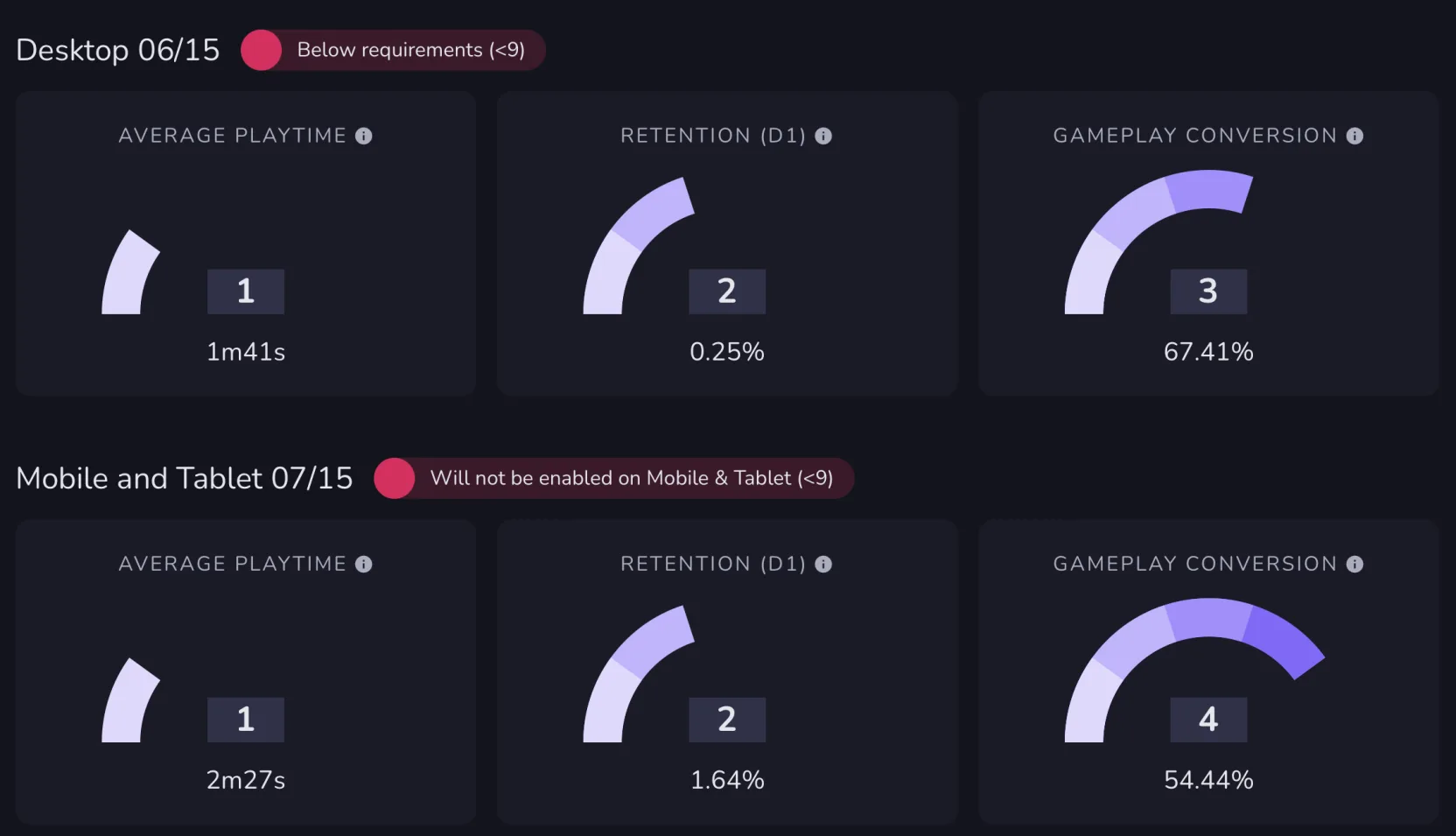
6/15 on desktop, 7/15 on mobile/tablet. Below the bar, so no full launch.
Conversion was my best score, meaning people did start playing. But average playtime landed at the bottom, and almost nobody came back the next day. The pattern above tells the whole story: a couple of rounds against the AI, and then off to the next game. A pure skill game with no progression gives most players no reason to return, and retention is exactly what a game portal lives on.
The email
In the middle of all this, an American player emailed me on my company email (which he found by following a link in the footer at play.airhockey.app). He had read my blog post about the multi-region setup and wanted to say thanks for putting a server on the US east coast, since that is where he lives.
The best part was how he found the game in the first place. He had asked ChatGPT for a real-time multiplayer air hockey game, and mine was the first browser based one it suggested. LLMs are quietly becoming a discovery channel of their own, and apparently a literal, descriptive game name goes a long way there.
Life after CrazyGames
The game no longer appears on the CrazyGames platform, but it keeps running at play.airhockey.app. The servers are cheap and the Elo ladder is still there for anyone who wants it. What is interesting is that two months later, a steady stream of new players keeps finding the game on their own. No portal, no promotion. Between search engines and LLM recommendations, the game apparently keeps getting discovered all by itself.
I will not chase the retention bar by bolting progression systems onto a two-minute arcade game. Instead, the lessons go into the next Dockside game.